Confidence Interval for a Known Population Standard Deviation
Learn how to calculate a confidence interval when the population standard deviation is known using a real-world example on teen screen time.
🎯 Goal: Estimating a Population Mean with Known Standard Deviation
In statistics, estimating the true population mean (\( \mu \)) using a sample mean (\( \bar{x} \)) is a core task in inferential analysis.
This post explains how to calculate a Confidence Interval when the population standard deviation (\( \sigma \)) is known — a scenario where we use the Z-distribution instead of the T-distribution.
📚 This post is part of the "Intro to Calculus" series
🔙 Previously: Introduction to Inferential Statistics: Point vs. Interval Estimation
🔜 Next: Confidence Interval for an Unknown Population Standard Deviation
📱 Real-World Case: Teenagers’ Daily Screen Time
Imagine you’re analyzing national survey data on teenagers’ daily screen time (phones, laptops, TV).
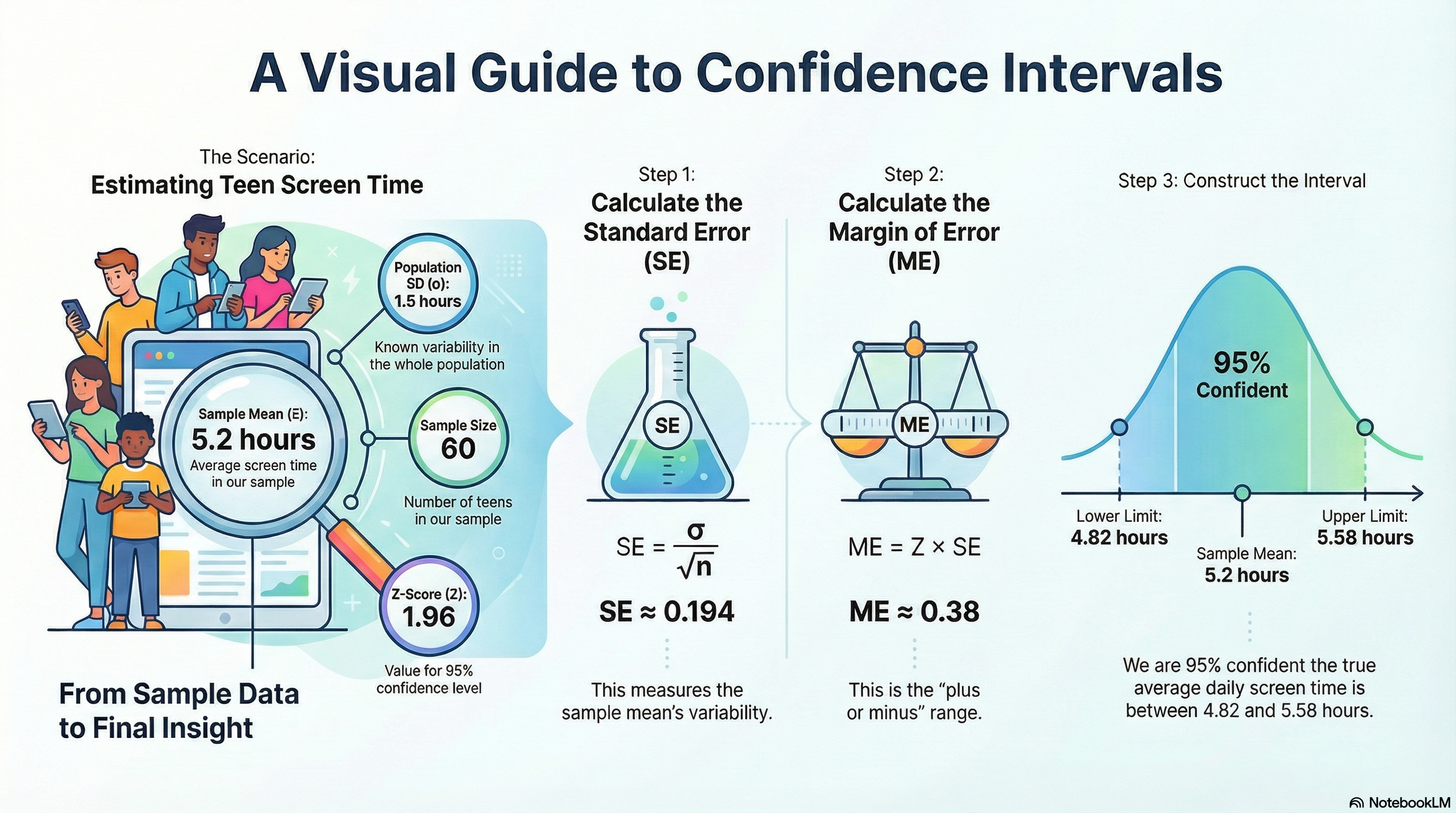
A previous nationwide health report tells us the standard deviation of screen time across the full population of teens is \( \sigma = 1.5 \) hours.
You’re working with a random sample of 60 teenagers, and you find that:
- Sample Mean: \( \bar{x} = 5.2 \) hours/day
- Known Population SD: \( \sigma = 1.5 \) hours
- Sample Size: \( n = 60 \)
- Confidence Level: 95% (Z = 1.96)
📊 Step-by-Step: Building the Confidence Interval
🔹 Step 1: Calculate the Standard Error
\[ SE = \frac{\sigma}{\sqrt{n}} = \frac{1.5}{\sqrt{60}} \approx 0.1936 \]
🔹 Step 2: Calculate the Margin of Error
\[ ME = Z \times SE = 1.96 \times 0.1936 \approx 0.3794 \]
🔹 Step 3: Construct the Confidence Interval
\[ \bar{x} \pm ME = 5.2 \pm 0.3794 \]
- Lower Bound: \( 5.2 - 0.3794 = 4.82 \)
- Upper Bound: \( 5.2 + 0.3794 = 5.58 \)
✅ Conclusion: We are 95% confident that the true average screen time among all teenagers is between 4.82 and 5.58 hours per day.
🧠 Level Up: Why This Matters for Machine Learning
In ML, you’re often making predictions on unseen populations. Whether it’s user behavior, healthcare diagnostics, or marketing trends — understanding confidence intervals helps model generalization.
- 🔍 Precision vs Confidence: A wider interval gives more confidence but less precision. A narrower interval is more precise but riskier.
- 🎯 If you want a narrower range, increase the sample size to reduce standard error.
🐍 Python in Practice: CI with Known Standard Deviation
1
2
3
4
5
6
7
8
9
10
11
12
13
14
15
16
17
18
19
20
import numpy as np
import scipy.stats as stats

# Given data
sample_mean = 5.2
sigma = 1.5
n = 60
z = 1.96

# Standard Error
se = sigma / np.sqrt(n)

# Margin of Error
me = z * se

# Confidence Interval
ci_lower = sample_mean - me
ci_upper = sample_mean + me

print(f"95% CI: ({ci_lower:.2f}, {ci_upper:.2f})")
📏 Quick Reference: Steps to Calculate
- ✅ Collect your data
- Sample size \( n \)
- Sample mean \( \bar{x} \)
- Known population standard deviation \( \sigma \)
- ✅ Choose your confidence level
- Common choices:
- 90% → \( Z = 1.645 \)
- 95% → \( Z = 1.96 \)
- 99% → \( Z = 2.576 \)
- Common choices:
✅ Calculate the Standard Error (SE)
\[ SE = \frac{\sigma}{\sqrt{n}} \]✅ Calculate the Margin of Error (ME)
\[ ME = Z \times SE \]- ✅ Construct the Confidence Interval
\[ \bar{x} \pm ME \]- Lower bound: \( \bar{x} - ME \)
- Upper bound: \( \bar{x} + ME \)
✅ Summary Table
| Component | Value |
|---|---|
| Sample Mean \( \bar{x} \) | 5.2 hours |
| Population SD \( \sigma \) | 1.5 hours |
| Sample Size \( n \) | 60 |
| Z-Score (95%) | 1.96 |
| Standard Error (SE) | 0.1936 |
| Margin of Error (ME) | 0.3794 |
| Confidence Interval | (4.82, 5.58) hours |
✅ Best Practices for Confidence Intervals with Known σ
- Know Your σ: This method only applies if the population standard deviation is already known from prior studies or reliable data.
- Use a Large Enough Sample: While the Z-distribution works with any sample size here, larger samples reduce the standard error and tighten the interval.
- Pick the Right Confidence Level: Choose your level (90%, 95%, or 99%) based on how much uncertainty you're willing to tolerate.
- Report the Full Interval: Don’t just state the sample mean — always give the range (e.g., 5.2 ± 0.38 or [4.82, 5.58]).
- Communicate Confidence Clearly: Explain what the interval means in plain language — it’s about method reliability, not a probability for one interval.
⚠ Common Pitfalls to Avoid
- Using Z when σ is Unknown: If σ is estimated from the sample, you should use the T-distribution instead of Z.
- Skipping the Square Root of n: Forgetting to apply the square root in the standard error formula leads to major errors.
- Thinking "95% Confidence" = 95% Chance: That’s incorrect — confidence refers to the long-run success rate of the method, not a single estimate.
- Assuming the Mean is Fixed: The sample mean \[ ( \bar{x} )\ \] changes with each sample — it’s not the true \[ ( \mu )\ \]
- Not Increasing n for Precision: Want a narrower interval? Increase the sample size — that reduces SE and tightens your estimate.
🧠 Level Up: Z vs T Confidence Intervals
There are two main ways to estimate a confidence interval for a mean:
- 🧠 Z-Interval: Use when the population standard deviation (σ) is known — typically from historical or scientific sources.
- 🧠 T-Interval: Use when σ is unknown and you estimate it using the sample standard deviation (s). This is much more common in real-world applications.
Knowing when to use Z vs T is a foundational skill in statistics and machine learning evaluations.
📌 Try It Yourself: Confidence Interval with Known σ
Q1: When should you use a Z-distribution instead of a T-distribution for confidence intervals?
💡 Show Answer
When the population standard deviation (σ) is known.
Q2: What formula is used to compute the standard error when σ is known?
💡 Show Answer
\[ \( \text{SE} = \frac{\sigma}{\sqrt{n}} )\ \]
Q3: Why does increasing the sample size reduce the width of a confidence interval?
💡 Show Answer
Because it decreases the standard error, making the margin of error smaller.
Q4: If a study reports a 95% confidence interval of [4.82, 5.58], what does this mean?
💡 Show Answer
It means that if the study were repeated many times, 95% of the calculated intervals would contain the true population mean.
Q5: You calculate \[ ( \bar{x} = 5.2 )\, ( \sigma = 1.5 )\, ( n = 60 )\ \] , and want a 95% confidence level. What’s your margin of error?
💡 Show Answer
\[ ( \SE = 1.5 / \sqrt{60} = 0.1936 )\ \], so ME = 1.96 × 0.1936 = 0.3794
🔜 What’s Next?
Now that you’ve mastered how to calculate a confidence interval with a known \( \sigma \), our next post will dive into how to estimate the population mean when the population standard deviation is unknown — using the T-distribution.
Stay tuned as we continue building your statistical intuition for data science and ML. 🎓📊
📺 Explore the Channel

🎥 Hoda Osama AI
Learn statistics and machine learning concepts step by step with visuals and real examples.
💬 Got a Question?
I’d love to hear your thoughts! Drop your questions, corrections, or topic suggestions below.