Microsoft Semantic Kernel: Why AI Applications Need More Than Prompts
Discover why Microsoft created Semantic Kernel and how it helps developers move beyond prompt engineering to build scalable AI systems using orchestration, memory, plugins, and AI agents.
🚀 Why AI Applications Are Changing
Building AI applications has become easier than ever.
Yet building production-ready AI systems has never been more challenging.
With just a few lines of code, developers can connect to a Large Language Model (LLM), send a prompt, and receive an intelligent response.
This simple interaction has powered thousands of AI-powered applications — from chatbots and writing assistants to code generators and document summarizers.
However, as organizations started moving from prototypes to real-world systems, a new challenge quickly emerged.
💡 Key Insight
Generating text is easy.
Building reliable AI systems is not.
A real-world AI application rarely needs to answer a question only once.
Instead, it often needs to:
- ● interact with external systems
- ● execute business logic
- ● retrieve organizational knowledge
- ● call APIs
- ● remember previous interactions
- ● coordinate multiple tasks before producing a final response
These requirements reveal an important limitation.
Large Language Models are excellent reasoning engines, but they are not application architectures.
This is exactly the problem Microsoft Semantic Kernel was designed to solve.
🎯 What You’ll Learn
By the end of this article, you will be able to:
- Explain why prompt-based applications have limitations.
- Understand why Microsoft introduced Semantic Kernel.
- Describe the architectural shift from AI chatbots to AI systems.
- Identify the key concepts that will be explored throughout this series.
🚧 The Problem with Prompt-Driven AI Applications
Most AI applications begin with a surprisingly simple architecture.
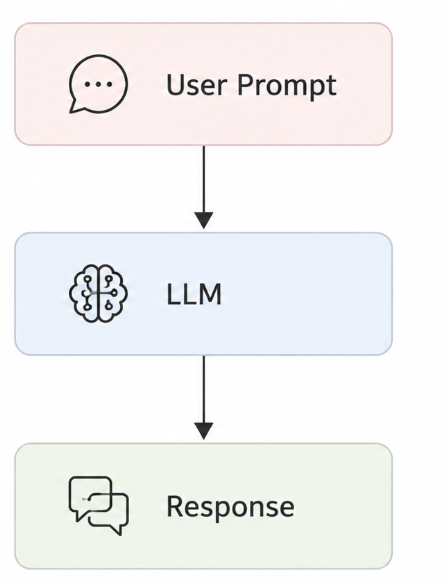
For learning, experimentation, and early prototypes, this architecture works remarkably well because it is:
- ● Simple
- ● Fast
- ● Easy to prototype
This pattern is powerful for simple use cases such as Q&A, summarization, content generation, and code assistance.
However, once we start building AI solutions for real businesses, this architecture quickly reaches its limits.
Example Scenario
“Analyze last month’s sales, compare them with our forecast, identify the biggest revenue drop, and send a summary to the management team.”
| User Perspective | Engineering Perspective |
|---|---|
| One simple request | A coordinated workflow involving data, business logic, and multiple execution steps |
To answer this request correctly, the AI application may need to:
| Required Capability | Why It Matters |
|---|---|
| Data access | Retrieve sales and forecast data |
| Calculations | Compare actuals against forecast |
| Business rules | Apply company-specific KPI logic |
| Analysis | Identify the biggest revenue drivers |
| Explanation | Generate a clear business summary |
| Integration | Send the result to another system |
💡 Key Insight
A language model was never designed to own the execution layer of an application.
Component Responsibility LLM Reasoning Application Execution
That means the system needs more than a good prompt.
A reliable AI system requires:
- ● tool access
- ● context
- ● application logic
- ● workflow coordination
- ● security boundaries
- ● failure handling
- ● observability
This is where many developers discover an important realization:
An LLM is an excellent reasoning engine, but it is not an application runtime.
The model knows how to think, but your application still needs to decide:
- what information should be provided
- which tool should be executed
- when a function should be called
- what happens if the tool fails
- whether another step is required
- when the workflow is considered complete
These questions are not prompt engineering problems.
They are software architecture problems.
⚠️ Prompt Engineering Can Improve Responses
Prompt engineering can improve the quality, clarity, and structure of model responses.
But it cannot replace the responsibilities of software architecture.
It cannot:
- manage workflows
- execute business logic
- call enterprise systems safely
- maintain application state
- handle failures and retries
Those responsibilities belong to the application architecture.
🧠 Architecture Insight
One of the biggest misconceptions in Generative AI is assuming that a better prompt can solve every problem.
In reality, many production challenges have nothing to do with prompting.
They involve orchestration, software architecture, security, observability, state management, and integration with existing systems.
Prompt engineering improves responses.
System engineering builds reliable AI applications.
🧩 Why Microsoft Created Semantic Kernel
Microsoft Semantic Kernel was created to address a very specific problem.
How can developers connect Large Language Models to real application capabilities in a structured, reusable, and enterprise-ready way?
According to Microsoft, Semantic Kernel is a lightweight, open-source SDK that helps developers build AI agents and integrate AI models into C#, Python, and Java applications.
However, the SDK itself is only part of the story.
The real value lies in the architectural mindset behind it.
Semantic Kernel acts as a middleware layer between the AI model and the rest of your application.
Instead of treating the LLM as the entire system, Semantic Kernel helps you connect the model to:
- ● existing code
- ● APIs
- ● plugins
- ● memory
- ● business logic
- ● external services
- ● orchestration workflows
In other words, Semantic Kernel gives the model a controlled way to interact with software capabilities.
This is what makes the shift important.
Without Semantic Kernel, many AI applications look like this:

With Semantic Kernel, the pattern becomes closer to this:
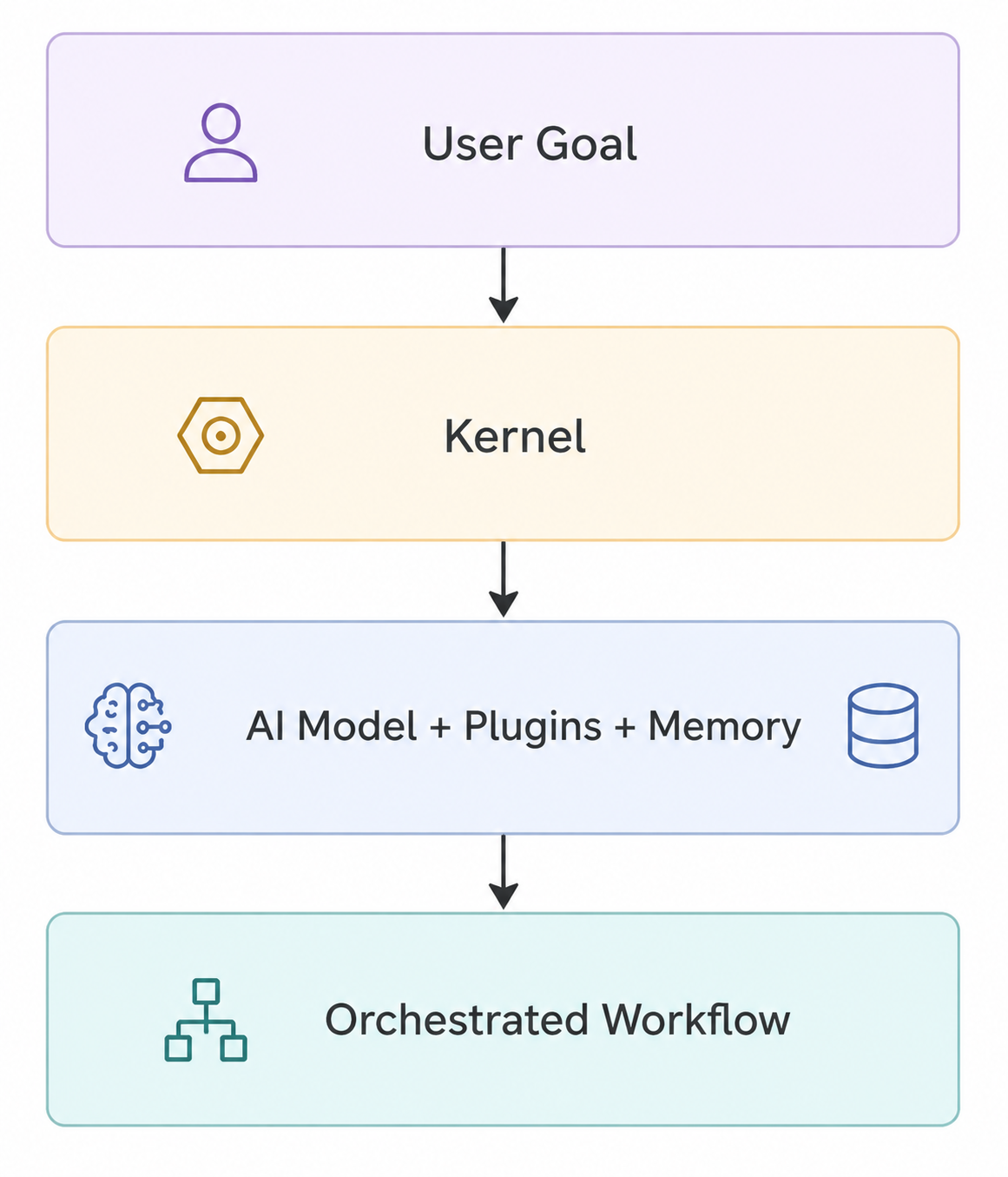
This is a very different way of thinking.
The model is no longer responsible for everything.
The application architecture becomes responsible for deciding what the model can access, what it can execute, and how the workflow should behave.
🧠 Architecture Insight
One of the biggest strengths of Semantic Kernel is that it separates responsibilities instead of concentrating everything inside the language model.
Rather than asking the LLM to do everything, we allow it to reason while the surrounding application controls execution, integrates external services, and enforces business logic.
This separation leads to AI applications that are more reliable, maintainable, and easier to scale in production environments.
✅ Key Takeaways
Microsoft Semantic Kernel matters because modern AI applications need more than prompts.
The main ideas are:
- Prompt-based applications are useful, but limited.
- LLMs are powerful reasoning engines, but they are not full application architectures.
- Reliable AI systems need tools, memory, business logic, orchestration, and safety boundaries.
- Semantic Kernel helps developers connect AI models with real application capabilities.
- The future of AI engineering is not only about better prompts, but better systems.
➡️ What’s Next
In the next article, we will go deeper into the core building blocks of Microsoft Semantic Kernel:
- Kernel
- Plugins
- Functions
- Memory
- Orchestration
Once it is published, I will add the link here.
This will help us understand how Semantic Kernel turns AI models into part of a larger, production-ready AI system.
📚 Official Microsoft Resources
For deeper technical context and implementation details, refer to the official Microsoft documentation: